
🟧 Should you write a Substack instead of a book?
People are paying more for newsletters than for printed volumes.
Today we have a handful of fun culture links and then media thoughtz from Kyle Chayka on the contemporary monetization of knowledge online versus in print, aka, should you start a paid newsletter??
Things of the week
A great, throwback magazine-style piece on writing about drinking cocktails right before the financial crisis, with an update on the grand hotel bars of Paris. Voicey af!!
The creator of Wordle launched his new word game, Parseword, which teaches us the niche activity of cryptic crosswords.
Nigo, the major international tastemaker and founder of the pivotal Japanese streetwear brand Bape and the newer brand Humanmade, is now obsessed with making ceramics.
Another Gaze is a feminist online film journal that just relaunched with a stack of great essays. Talk about building better cultural discourse.
We enjoyed Elvia Wilk’s interview of Andrew Martin, the millennial novelist who has a new novel out, Down Time, about millennial writers. Wilk, a great critic and novelist herself, inquires into the underbelly of making fiction.
Pitchfork goes very long on a single synth-heavy track from the soundtrack of Donkey Kong Country 2, in case you thought music criticism was dead.
The difference between Substacks and books
by Kyle Chayka
If you want to sustain a career as a creator of culture, you have to make money. Different kinds of artists do this in different ways. Painters sell a bunch paintings once every few years and split the prices with their dealers. Musicians get minuscule streaming checks and sell concert tickets and t-shirts. Comedians go on tour and sell rights to their streaming specials. Writers sell books — kind of. Only one out of five books, and probably far fewer than that, earn more money in sales than the author was paid as an advance, so real income from royalties is quite rare. Enough books hit it big that the longterm economics still work out for publishers, at least. Meanwhile, less-than-bestselling authors have to survive any way they can: teaching classes, hosting writing retreats, selling their clothes on Depop — or charging subscriptions for a newsletter.
Substack newsletters have been an economic lifeline for any number of writers who don’t quite fit in to a slot with an institutional salary. I see art journalists and radical novelists and longform magazine writers (among other semi-extinct breeds) paywalling their latest dashed-off dispatches. That’s because in business terms — and we are all businesses in the end — the subscription newsletter works extremely well. There’s a business concept called “lifetime value”, LTV, that refers to the amount of money a business can expect to make from a new customer on average over the duration of the relationship. For a writer, the LTV of a Substack subscriber is many times higher than the LTV of a book buyer. A Substack subscriber pays monthly at a rate of $5-$10ish, the price that seems to have been found acceptable for some emails by the internet marketplace. That amounts to perhaps $100 a year, and many subscribers, like many gym members, hang on to subscriptions for far longer than they use them, out of loyalty or laziness. An author could make $300 in LTV from a single new subscriber, while a single book sale could net $5, or maybe $20 if you write enough books in a career.1 It’s a quirk of digital consumer habits that right now knowledge (or storytelling) is better monetized in an email than a book. Maybe we can say that newsletters better monetize an individual’s fandom, while a book better monetizes fandom at scale, hundreds of thousands of people at once, for the already famous.
I will get to the differences between the two formats and the many caveats to this thesis later on. But as they presumably teach you in MBA school, it makes sense for a business to try harder to market and sell the product that makes more money. For many authors, particularly those with a pre-existing platform to work from, hustling to convert a new newsletter subscriber is likely much more profitable (again, on a single-customer basis) than working on a new book. That could be viewed as a good thing, because the labor that goes into writing a book should be valued much higher than it is. A reader doesn’t pay a higher price for a physical book just because she wants it more, or because the book was harder to create; prices are relatively flat, whether it’s by a niche poet, an abstruse historian, or a big-idea blogger. A print book is also not necessarily the ideal container for the kinds of knowledge- or culture-production that happen in our video / audio / image-dominated digital environment. Email newsletters with multimedia embeds might make more sense for contemporary consumers, who in turn pay more money for them. Radically more money.
I think this underrecognized phenomenon was behind the shock at a “Fashion Substacker” highlighted in New York Magazine who made an annual $127,000 from Substack subscriptions and $148,300 from brand partnerships (that is, sponsored content presumably in their newsletter and social accounts). “I am making more than I ever could as a journalist,” the person said. That’s because their individual writing, and the scope of their influence, is valued much more highly by subscribers and brands than, say, the salary for a full-time job at NYmag’s The Strategist. In a way, larger media companies have lost track of the true value of unique content and aren’t particularly good at capturing the value of unique voices. Add to that the decline of institutional credibility — audiences may rather follow a single influencer / creator than subscribe to a magazine’s curated collection of voices — and there’s a real quandary.
So should a writer just embark on a Substack rather than a book and scramble to accumulate any paid subscribers she can? The whole idea is kind of facetious — you don’t have to choose, because newsletters and books are mutually reinforcing. A Substack audience is more likely to buy your eventual book and satisfied book readers are more likely to pay for a newsletter. (The writer Casey Johnston very successfully transformed her fitness column Ask a Swole Woman into paid newsletters, courses, digital community, and a book all at once.) A newsletter can be a kind of iterative book manuscript, a way to broadcast and test material and find out what resonates with audiences, the way a business might carry out focus groups or market testing. A book can also transform the inherent value of a trove of newsletters into a new form and reach new audiences out in the real world, on bookstore shelves. Books are meant to be evergreen and portable, while newsletter archives don’t get much attention. (There’s a ton of value to be extracted from evergreen newsletter archives. The click-through rates to old One Thing editions are huge.)
One Thing is a weekly newsletter about quality in culture. Subscribe here.
The downside of the new, paywalled Substack Ecosystem of Knowledge Monetization is that no one is going to help you succeed. No publisher is going to pay you an advance, though I dream of Simon & Schuster subsidizing a new writer’s Substack in exchange for royalties forever. No one is going to edit your newsletter unless you pay them to do it, no one is going to design you a beautiful cover, no one is going to line up bookstore launches for you. There’s no clout to starting a newsletter, unlike publishing a book, precisely because there’s no gatekeepers. Like all forms of social media, newsletters are also quicksand. You start out with high aims, promising literary reviews; deep-reading or watching projects; feature reporting dug from the far reaches of the internet or the real world. But soon you’re paywalling your breakfast habits, capsule winter wardrobe, and Mallorcan hotel recommendations (nothing wrong with that). Everything devolves into recslop. As Emily Sundberg wrote in a major critique of the Substack platform in 2024, it’s a great place for people to “monetize their diary entries — lists, random thoughts, and (easy to write) roundups of ‘what I’ve been doing’ do really well on this site.” When your diary entries are so profitable, why write anything else?
The iterative, ongoing, and intimate nature of a newsletter feeds the online demand for parasocial content, content that encourages audiences to imagine they know its creator personally in a kind of one-sided digital friendship. A book commodifies one carefully composed edifice of knowledge, while a newsletter commodifies the patter of someone’s internal monologue. A book might be read in a century or two’s time; a newsletter will not be. (The only blogs / newsletters that should be remembered by posterity are Patrick Tsai and Madi Ju’s My Dead Little Dick and Tsai’s Talking Barnacles.) Books are not the most parasocial medium, but they are the best form we’ve invented for a reader drawing close in a sustained way to the consciousness of another human being. So if you’re trying to construct a monument to your own genius, a book is probably your best bet. Just ask Proust.
That said, as this essay began, creating culture takes resources, and when everyone is an influencer, you might as well commodify yourself as an influencer does. They make way more money.
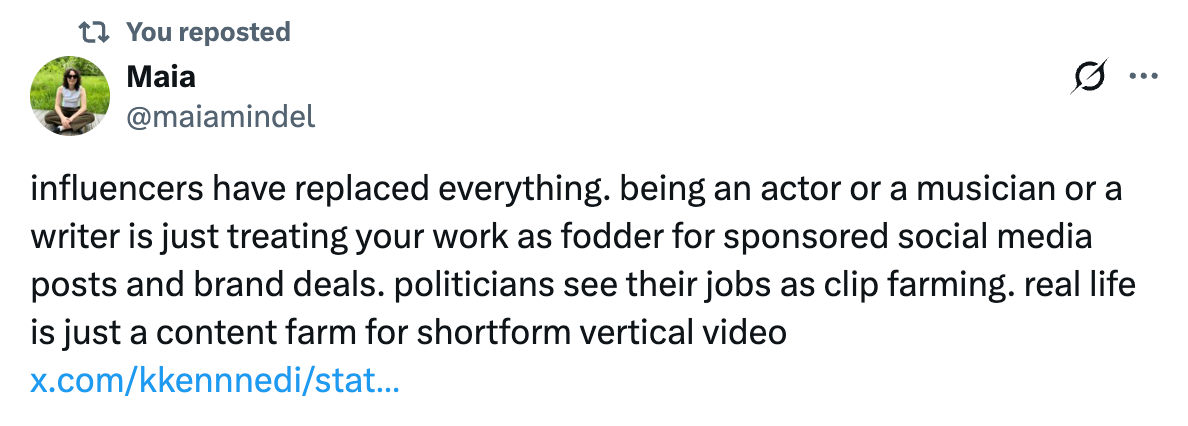
More Media Thoughtz from One Thing:
Gathering attention: How to re-organize audiences and focus their attention on the fragmented internet.
Conversations are the new unit of culture: Why people talking to each other and the performance of expertise have become so important.
The new rules of media: 20 guidelines for digital media during the video-podcast age, aka, why you need a personality cult.
What makes a good newsletter?: An expert roundtable about newsletter strategy. Are there too many!? Does good writing matter!?
Aggregation theory: More writers and publications are focusing on creating valuable aggregation because social media sucks so much.
Voice, taste, trust, scarcity: The values that publications need to keep in mind while competing for readers in the new, messy ecosystem.
Ideally, your customer acquisition cost (CAC) — how much money it takes to attract a new buyer — is lower than your LTV. Then you have a profit machine.
That was great, and incredibly helpful! Serializing my new timely countercultural novel on my Substack, as a weekly tightwire act, starting NEXT WEEK!!! As a New York Times bestselling author in the previous century, now moving full-tilt into the Creator Economy in my wildass dotage, this is one of the most exciting things I've ever done. WOOOO-HOOOOOO!!!