
🟧 Virtualized tennis
Watching sports is getting algorithmic.
Nate Gallant: Televised sport is beginning to slip away from the collective view. I mean this metonymically but also quite literally, and when those things align, you know we’re in trouble.
For better or worse, because of how media rights works especially in the US and the UK, if you want to watch the World Series or Real Madrid matches, or whether Taylor Swift’s boyfriend will make it to the Super Bowl and finally propose to her, you have to watch the same feed with the same color commentary and the same camera angles as everyone else tuned in on TV. The proliferation of algorithmically curated social media feeds, polarized news content, and streaming media has, in many other parts of our media diet, given rise to a set of static platforms and thus a fixed body of media aesthetics for presenting different content. Each type of content is siloed into self-reproducing bubbles made up of political bent, identity axis, or niche interest. To some extent, the sports viewing experience has remained relatively communal, both in content and form.
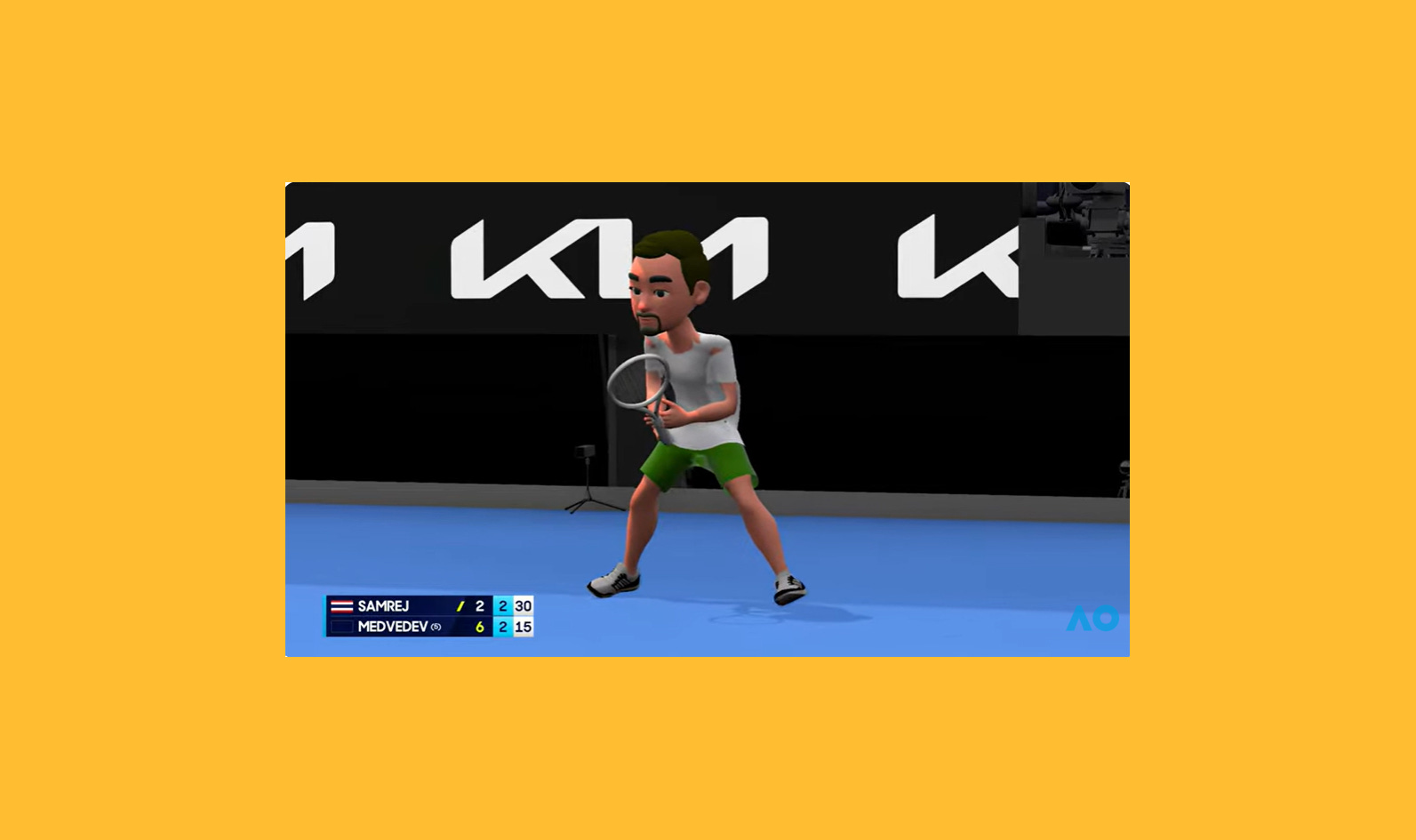
Yet the other day, jet-lagged and too awake at 4:30 AM, I excitedly realized that the Australian Open, the professional tennis calendar’s first big tournament of the year, had likely started and it was prime time to catch some early round matches. Having cancelled my fairly expensive Youtube TV subscription I went to Youtube itself and was happily surprised to see that the tournament’s sponsored page was streaming a match live. When I clicked on the feed I saw the very familiar, very aqua-blue palette of the Melbourne hard-courts, the usual melange of ads for Chinese whiskey and air-conditioners, the chair umpire and the crowd, and even some quiet color commentary. However, everything suddenly snapped into unreality. In place of the players were slightly wiggly, very unathletic looking cartoon avatars where I expected to see the whips and springs and muscular ripple of world-class athletes fighting for a second round spot. The cartoons were thwacking what looked like a giant cartoon softball back and forth. The ad-bedecked background then followed, looking less cartoonish but clearly meant to replicate the unreality of the Wii-ish, AI characters now playing the match.
This was no glitch, but the result of an expensive-seeming directive on the part of Tennis Australia to create live, AI generated “skins” for the athletes at the Australian Open, which in real time replicates their and the ball’s movements for live-streaming on Youtube. It’s a strategy to get around the lack of distribution rights on some channels of the game itself; instead, you experience a real-time simulacrum.
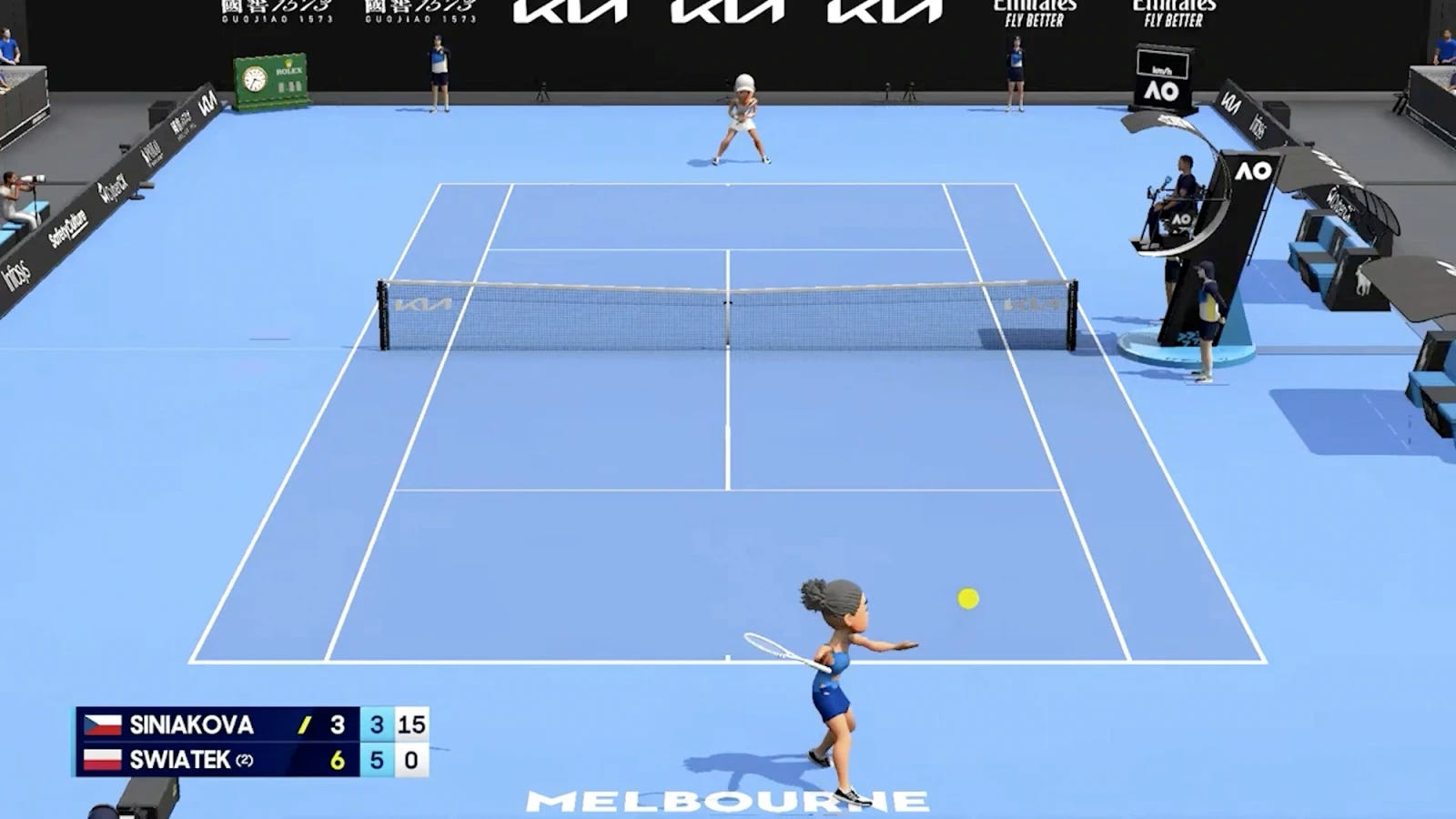
Player reactions were sanguine, if not confused. But personally I was not struck in a moment of analytic stupor or even uncanny recognition of the virtual invading reality. Nor did I see the “magic” that Tennis Australia’s “Director of Innovation” responsible for this particular bit of digital advertising supposed would result from “taking the real into the unreal.” I was just disappointed to see yet another piece of sports media buckling to the pressures of customization, creating new angles for monetizing the viewing experience.
Like everything, this was a joke on TikTok and YouTube long before it was the directive of some corporate entity. And it fits in the context of a much longer story. Since the rise of sports gaming and then subsequently Twitch, there has always been an alternative market for watching a reproduction of virtual sport. And the “real thing” has long been subject to re-organization based on these new forms of visual consumption. As The Athletic’s senior writer and former chief NYT soccer correspondent Rory Smith has pointed out in his book Expected Goals, the rise of data in soccer, as well as sports in general, was occasioned, at least from a fan’s perspective, by the fact that beginning in the late ‘90s fans began to consume an increasing amount of sports media through video games. This emphasized a set of very legible statistics for player speed, skill, and various other powers, as well as one’s own personal wins, losses, in campaign/manager modes. This no doubt contributed to the rise of watching other people perform virtuosically in a video game itself, both for its own beauty to those who can recognize the heights of such a performance, but also perhaps inviting more of a sense of participatory viewing from those who had more access to playing soccer virtually than on a pitch themselves.
A customizable experience, which at the very least invites the participation of viewers to choose their preferred camera angle, has been available in tennis, too, for some time. Many viewers watching on app or streaming services can choose whether they watch a match from the classic top-down view or a court-level view. The classic top-down angle shows a static shot from one player’s side over the entire match, variously flipping to alternate views between points to highlight the sweat-stains and broken rackets and myriad celebrities in the audience.
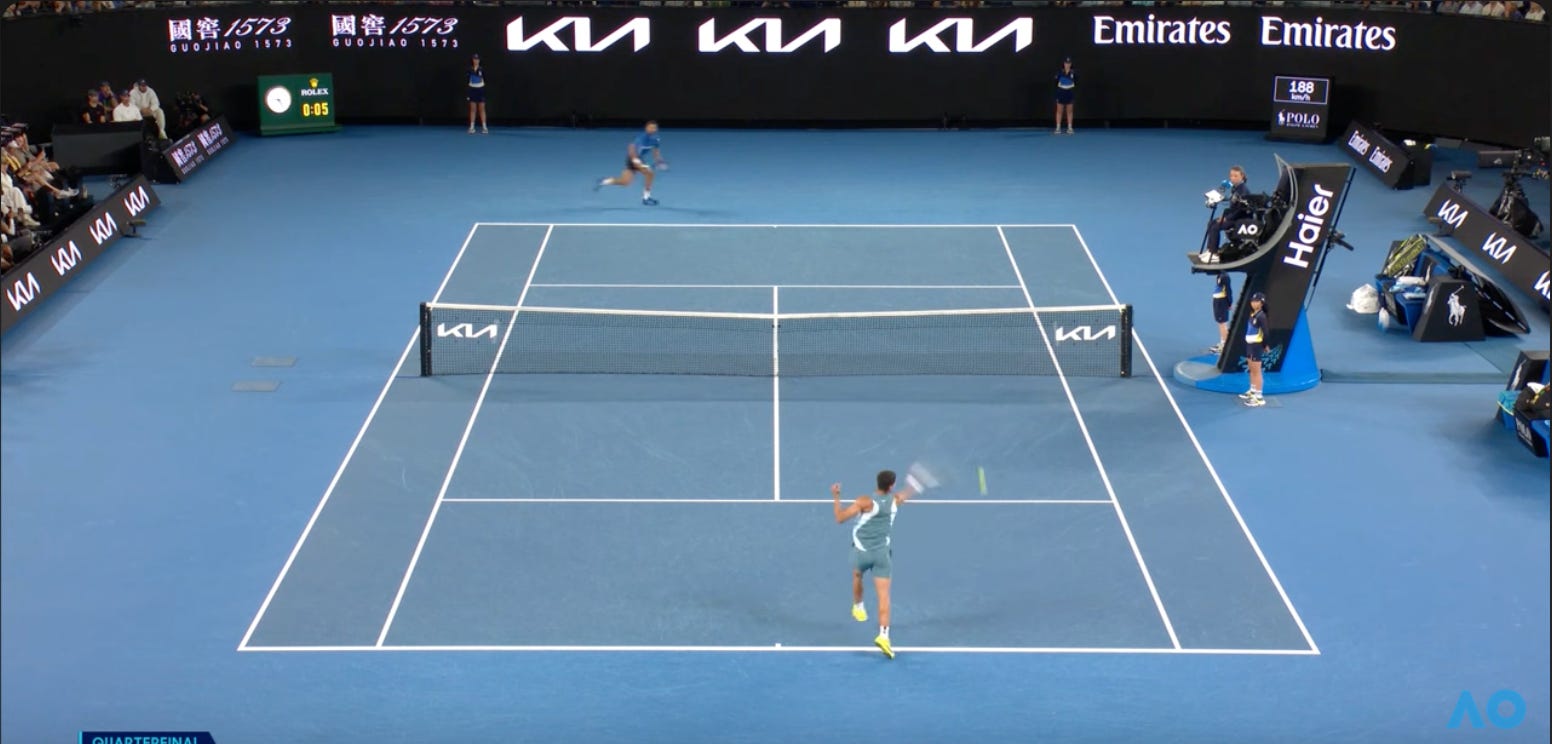
From the standard top-down vertical shot you see the whole court, one player in the foreground and one in the background, and so the acrobatic movement, the speed of each player sprinting in their respective halves, and ball’s flight are in the best view. The width of the court frames the entire view. The contrasting, court-level angle is, I think, something of a tennis purist’s perspective: a camera has long been placed directly behind one of the players to show the bodily contortions and power of a winner or the bulging muscles in perfect alignment in the slow-motion replay of a serve. Now, however, you can watch an entire match from this much more horizontal view.
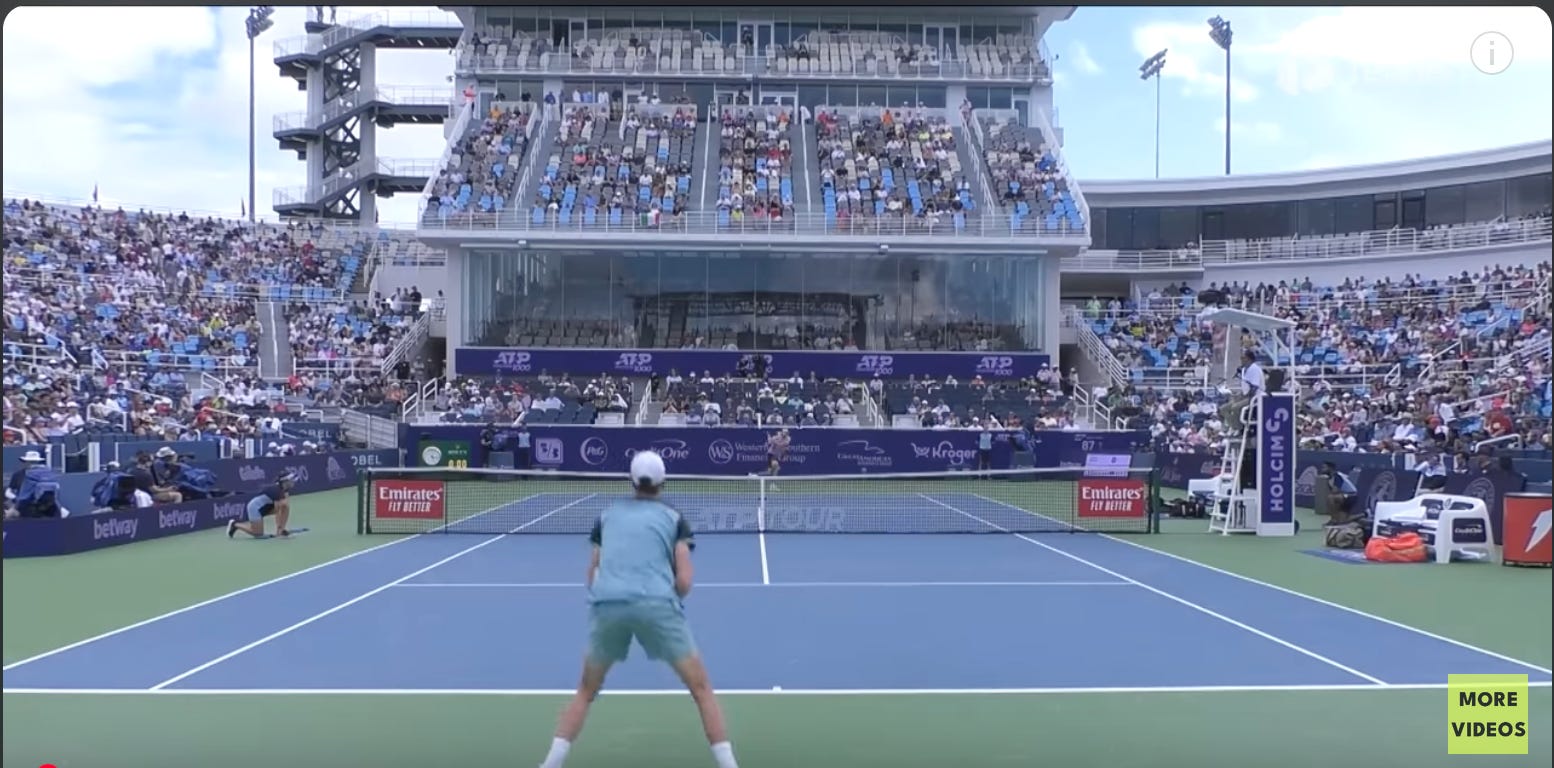
For those who admire the purity of the most cleanly hit forehand they could ever dream of hitting over and over again, or perhaps just want to stare at the very toned rumps of professional athletes, this view is potentially preferable. (Perhaps not coincidentally, it’s also the camera angle of plenty of tennis content on TikTok, the camera right behind the creator.) But having the choice between angles still strikes me as innately destabilizing, on the same level as the players being replaced by cartoons of themselves. From the various visual presentations to the tiered commodification of our attention, are we all even watching the same match anymore?
Beyond annoyingly strangling the sport-watching experience into unnecessary, more expensive formats, it makes me wonder what such a fundamental re-mediation of the perspectives on sports might do? Given the enormous import of televised sport as social glue, driver of an enormous industry of secondary media, and an odd medium of cosmopolitan fandoms across the globe, what the consequences might be for this “most important of the least important things.”
Recently on One Thing
Look back through the archives for OT’s greatest hits. We send out short newsletters on taste, authenticity, and recommendation culture every Tuesday and Thursday.
My grandparents’ lamp: On adopting an inherited object into your home and the intimacy of daily routine.
Chasing a vibe pic: Where did this moody streetscape in a meme come from? On the globalized, contextless internet, origins are mysterious.
The year in connoisseurship: We talk a lot about “taste,” which turns people off. It might be better to be a connoisseur than a tastemaker.
The new rules of media: 20 guidelines for navigating the 2025 internet, from developing personality cults to being hot.